Math Calculators
Math calculators on Math Lantern solve the problem and show every step. Pick a calculator below, type your numbers and watch the working appear line by line, from the first rule to the final answer. Use it to check homework, learn a method or plan a lesson.
Working
All calculators, by topic
35 calculators are planned. Each page starts with the working tool, then explains the method with a worked example. Names marked “soon” are in the publishing plan and go live on their dates.
Algebra
- Factoringsoon
- Quadratic formulasoon
- Simplifysoon
- Exponentssoon
- Scientific notationsoon
Number sense
- GCFsoon
- LCMsoon
- Ratiosoon
- Proportionsoon
- Long divisionsoon
- Integers with stepssoon
- 4-functionsoon
- Mixed numberssoon
- Decimal to fractionsoon
Rounding & estimating
- Roundingsoon
- Nearest hundredth
- Sig figs
- Significant figuressoon
- Estimating a sumsoon
- Estimating sumssoon
Percent & money
- Percent offsoon
- Discountsoon
- Percentage decreasesoon
Geometry
- Pythagorean theoremsoon
- Circle areasoon
- Circumferencesoon
Statistics & charts
- All statistics calculators
- Standard deviation
- Average
- Meansoon
- Probability
- Binomial distribution
- Z-value table
- Place value chartsoon
- Unit circle chartsoon
Why seeing every step matters
A final answer tells you whether you were right. The steps tell you why. When you can read each line of the working, you can find the exact place where a method went wrong, copy the structure to a new problem and explain the idea to someone else. That is the difference between checking an answer and learning a method.
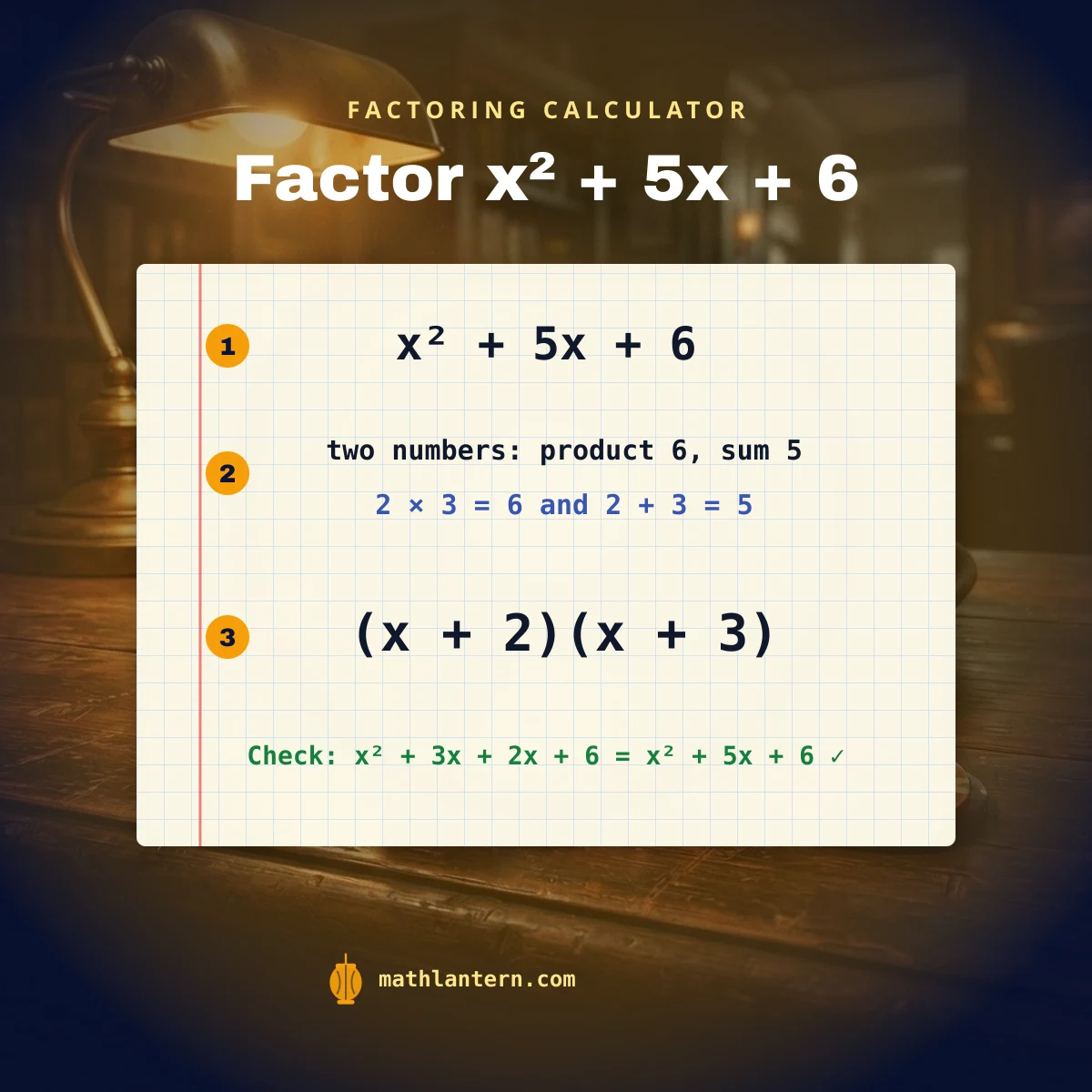
Greatest common factor and least common multiple
The solver uses the Euclidean algorithm. Divide the larger number by the smaller one, keep the remainder, and repeat with the smaller number and the remainder until the remainder is 0. The last non-zero remainder is the GCF. The LCM of two numbers is their product divided by their GCF.
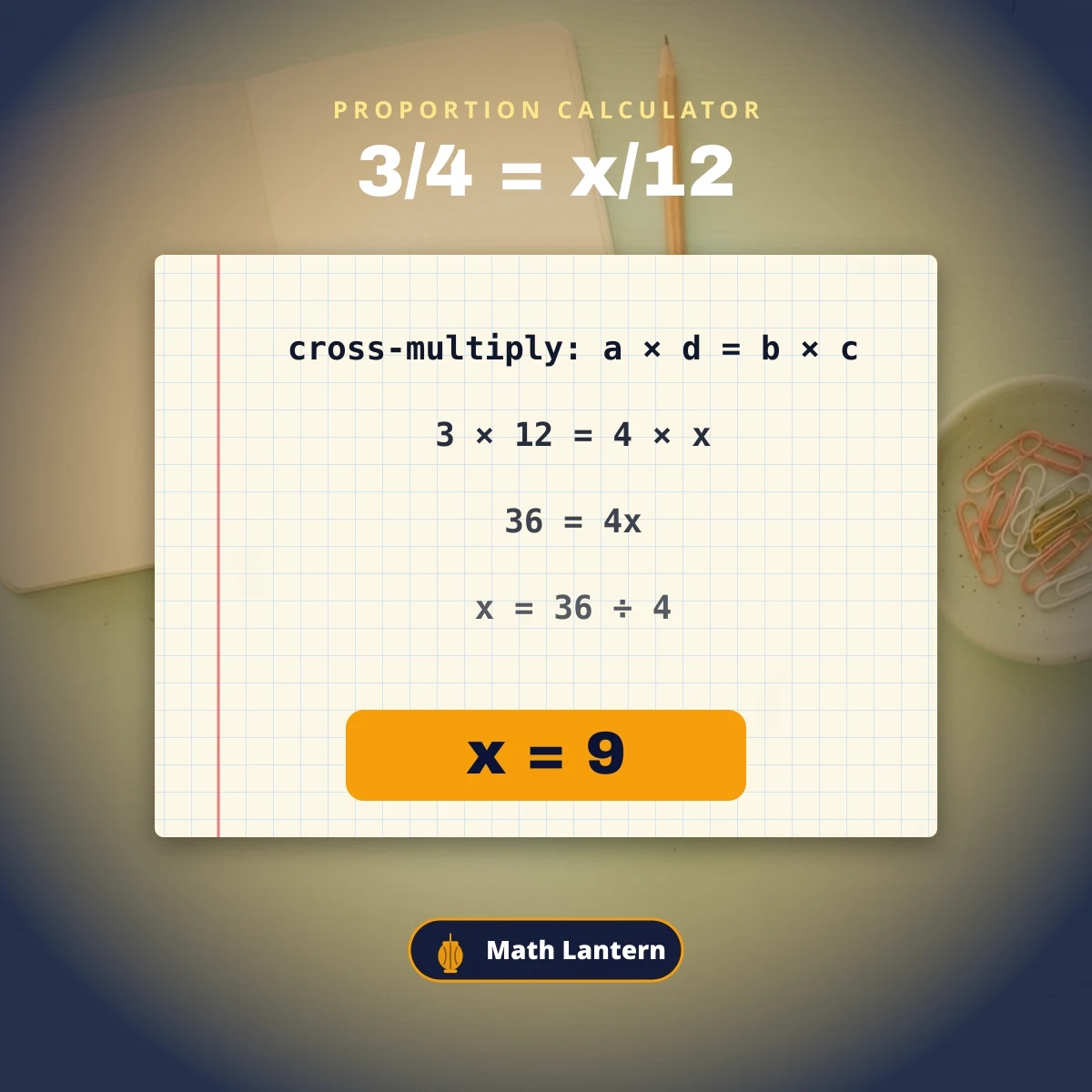
Solving a proportion
Two ratios are equal when their cross products match: a/b = c/d means a × d = b × c. Leave one box empty and the solver isolates it. For 3/4 = 9/x, cross-multiplying gives 3x = 36, so x = 12.
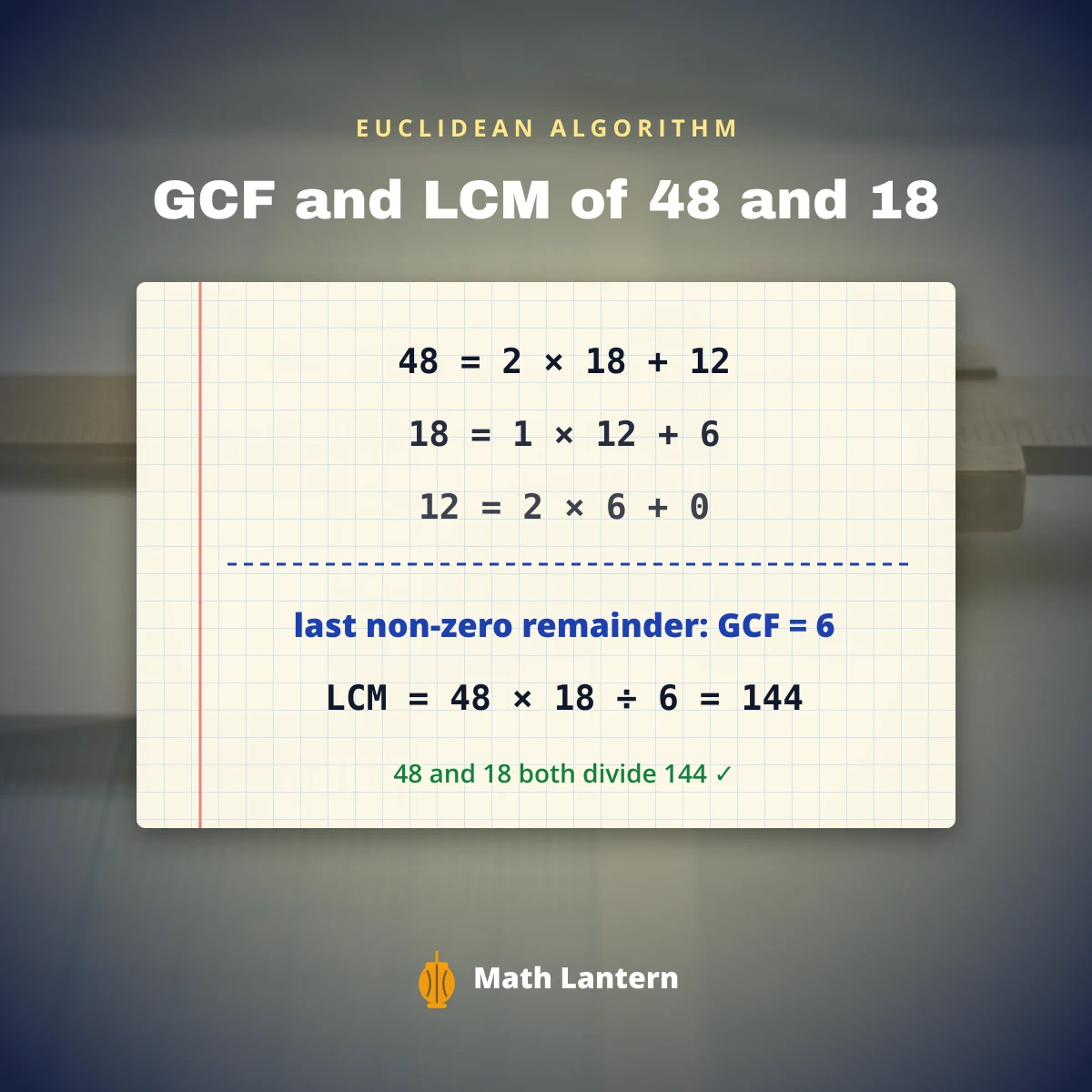
The quadratic formula and the discriminant
| Discriminant b² − 4ac | Roots | Graph touches the x-axis |
|---|---|---|
| Positive | Two different real roots | At two points |
| Zero | One repeated real root | At one point |
| Negative | Two complex roots | Never |
The formula is x = (−b ± √(b² − 4ac)) ÷ 2a. For x² − 5x + 6 = 0, the discriminant is 25 − 24 = 1, so x = (5 ± 1) ÷ 2, giving 3 and 2.
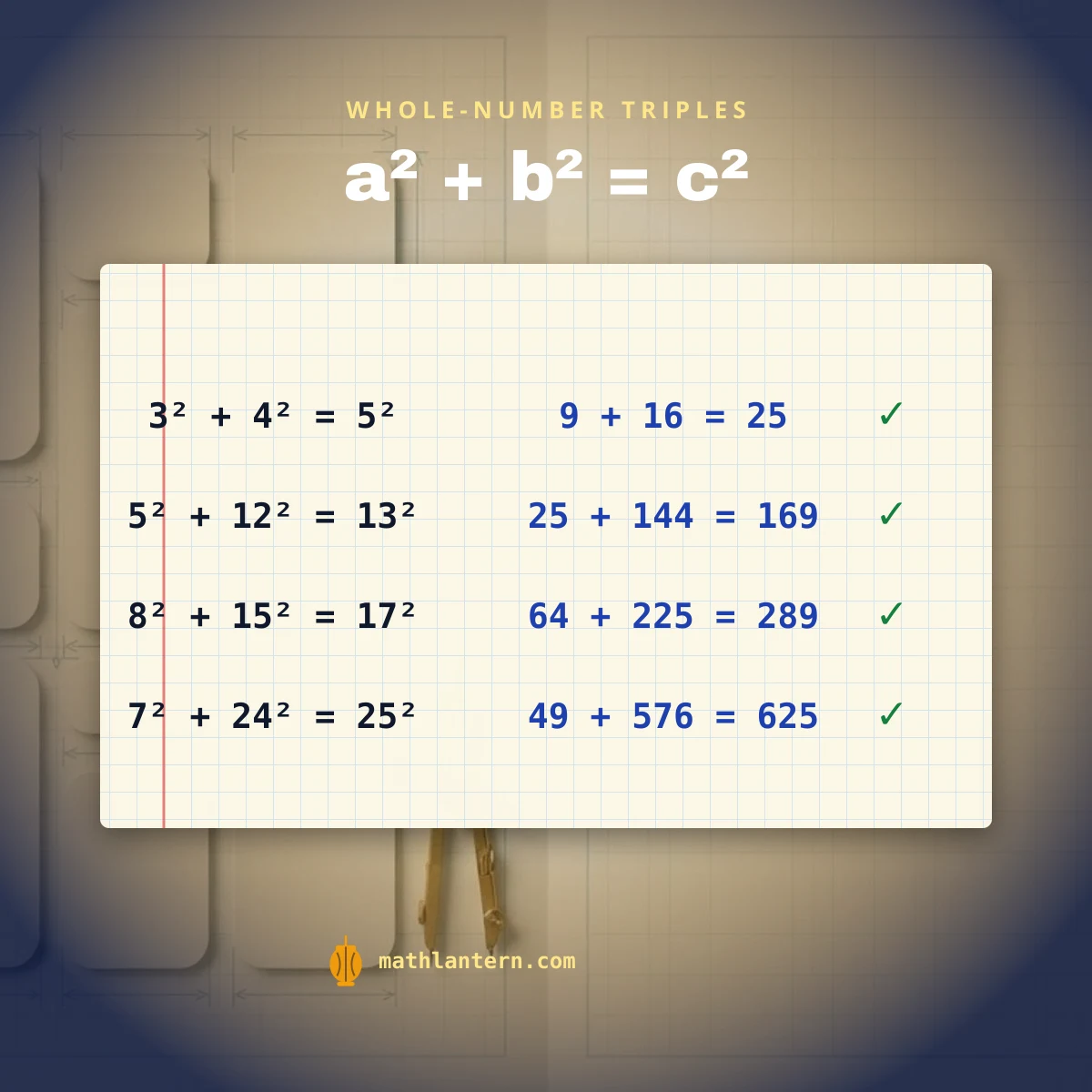
Pythagorean theorem and common triples
In a right triangle, the squares of the two legs add up to the square of the hypotenuse: a² + b² = c². Some whole-number triples show up again and again.
| a | b | c | Check |
|---|---|---|---|
| 3 | 4 | 5 | 9 + 16 = 25 |
| 5 | 12 | 13 | 25 + 144 = 169 |
| 8 | 15 | 17 | 64 + 225 = 289 |
| 7 | 24 | 25 | 49 + 576 = 625 |
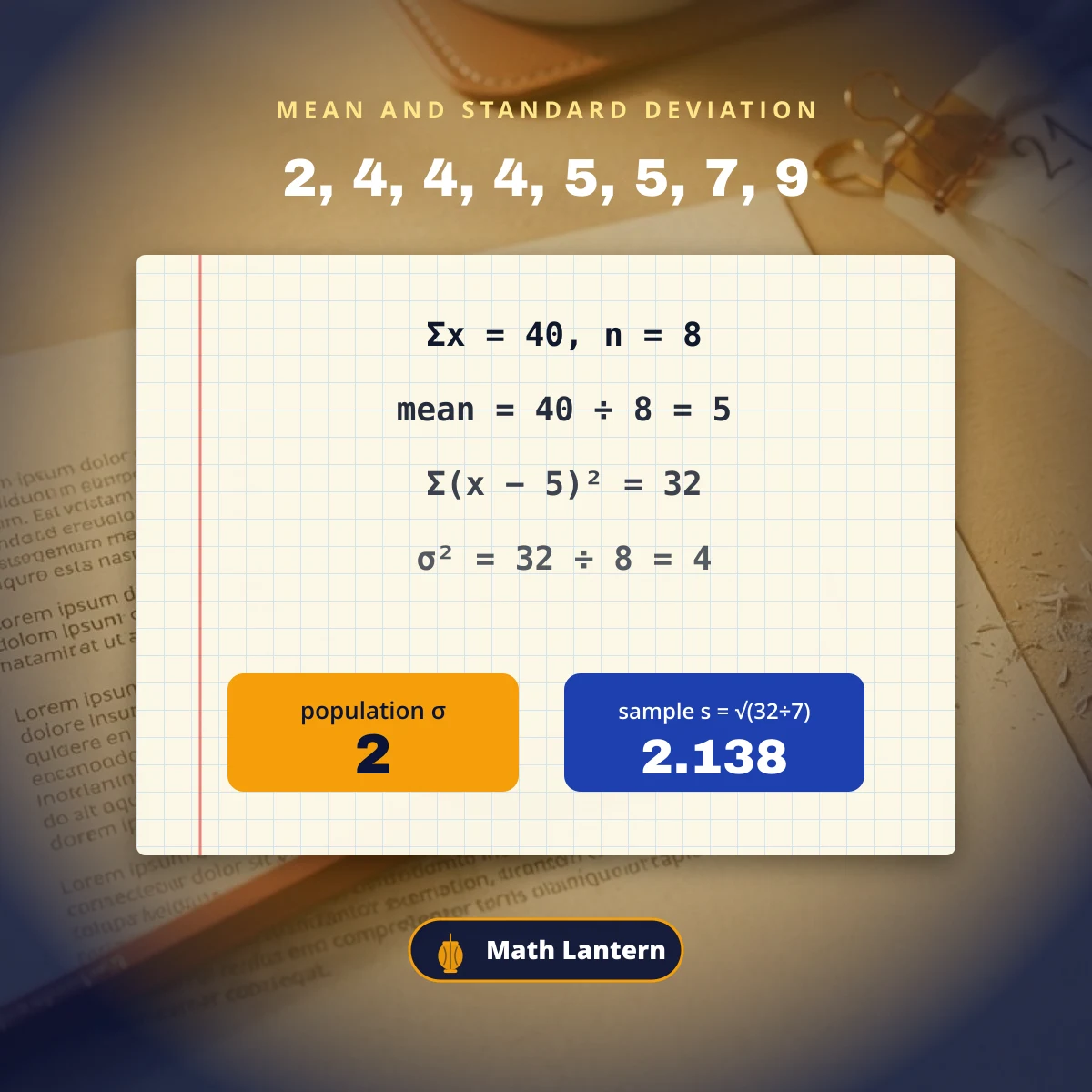
Mean and standard deviation
The mean is the sum divided by the count. The standard deviation measures how far values typically sit from the mean. Subtract the mean from each value, square the differences, add them up, divide by n (population) or n − 1 (sample), then take the square root.
How to get the most from a worked solution
- Cover the steps, try the problem yourself, then reveal one line at a time.
- When your line differs, stop there and work out why before moving on.
- Change one number and predict the new answer before pressing Solve.
Frequently asked questions
Do the calculators only give the answer?
No. Every result comes with the working, one line at a time: the rule used, the numbers substituted and the arithmetic. You can reveal the steps one by one or all at once.
Can I use it to check homework?
Yes. Solve the problem on paper first, then compare your steps with the calculator. If a line differs, that is usually where the mistake is.
What is the difference between GCF and LCM?
The greatest common factor (GCF) is the largest number that divides every number in the list. The least common multiple (LCM) is the smallest number that every number in the list divides into. For two numbers, GCF × LCM equals their product.
What does the discriminant tell me?
For ax² + bx + c = 0 the discriminant is b² − 4ac. If it is positive there are two real roots, if it is zero there is one repeated root, and if it is negative the roots are complex.
Population or sample standard deviation?
Use the population formula (divide by n) when your list is the whole group. Use the sample formula (divide by n − 1) when the list is a sample taken from a larger group.
Is my input saved?
No. All the math runs in your browser. Nothing you type is sent to a server.
Did this light the way?
Tell us if the steps made sense or where they lost you.
Thanks. That helps us make the next step clearer.