Probability Calculator
A probability calculator works out the chance that events happen together or separately. Enter the probability of A and B, and it returns A and B, A or B, neither, exactly one, plus the chance of at least one success in n tries, assuming independent events.
| Question | Formula | Result |
|---|
Working for “A and B”
Math Lantern Team · Updated
How the probability calculator works
Enter the chance of event A and event B and the calculator returns the probability of A and B, A or B, neither, exactly one, and the chance that A happens at least once or every time in n repeats. It assumes the events are independent and shows the working for A and B.
Worked example
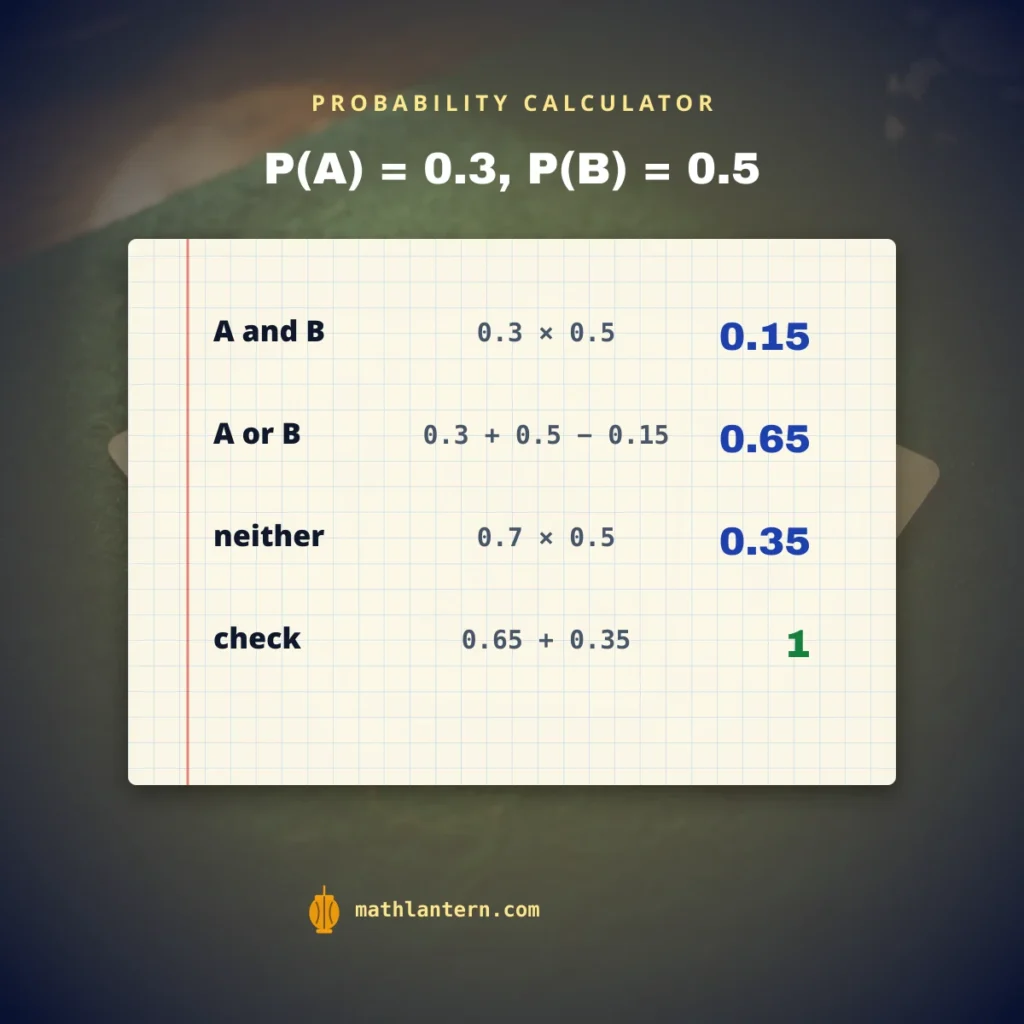
Let P(A) = 0.3 and P(B) = 0.5. Both happen with probability 0.3 × 0.5 = 0.15. Either happens with probability 0.3 + 0.5 − 0.15 = 0.65. Neither happens with probability 0.7 × 0.5 = 0.35, and 0.65 + 0.35 = 1 confirms the numbers add up.
“At least once” in repeated tries
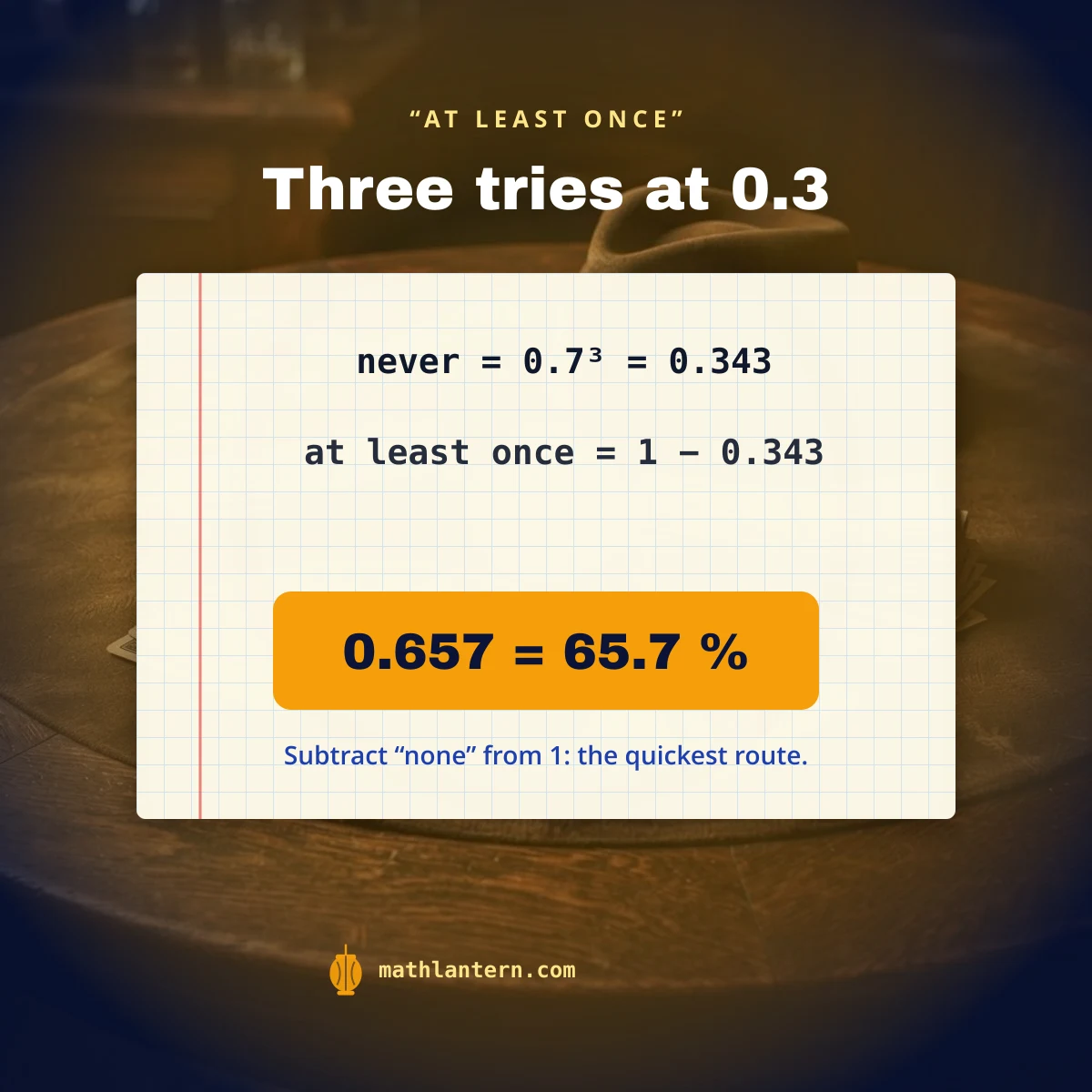
The quickest way to find the chance of at least one success is to subtract the chance of none from 1. If A has probability 0.3 and you try three times, the chance of never is 0.7³ = 0.343, so at least once is 1 − 0.343 = 0.657, or 65.7 %.
Independent versus dependent events
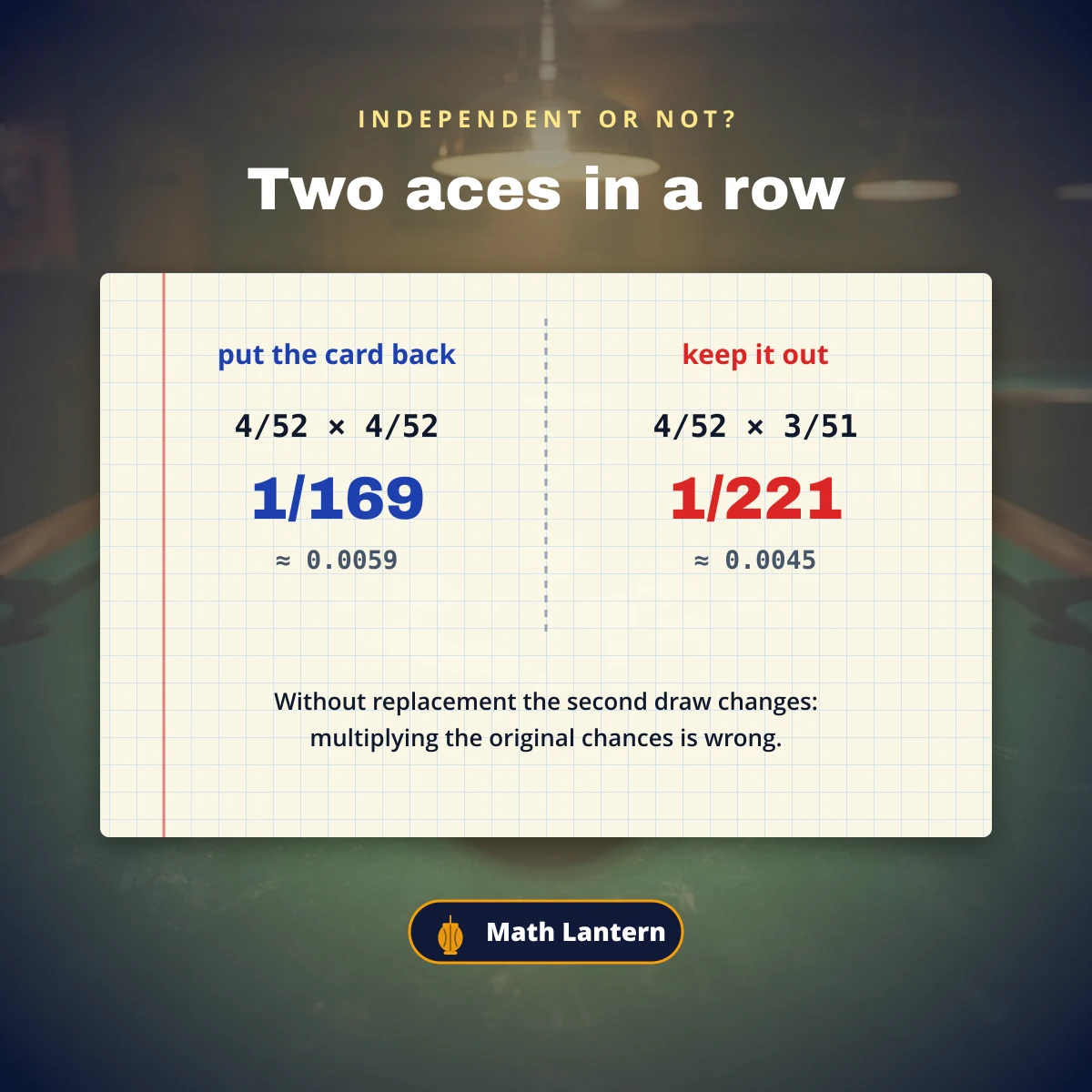
Events are independent when one outcome does not change the chance of the other, like two separate coin flips. If you draw two cards from a deck without putting the first back, the events are dependent and multiplying the original probabilities gives the wrong answer. Two aces in a row is 4/52 × 3/51 = 1/221, not 4/52 × 4/52 = 1/169; use conditional probability instead.
- Probabilities are always between 0 and 1.
- P(A or B) can never be smaller than the larger of P(A) and P(B).
- P(A and B) can never be larger than the smaller of the two.
Frequently asked questions
How do I calculate the probability of two events?
For independent events, multiply their probabilities for “and” and use P(A) + P(B) − P(A)·P(B) for “or”.
What does “at least once” mean?
One or more successes. Compute it as 1 minus the chance of no successes in all tries.
Can I enter percentages or fractions?
Yes: 30%, 0.3 and 3/10 all work.
See the Factoring Calculator home page for more step-by-step tools.
Did this light the way?
Tell us if the steps made sense or where they lost you.
Thanks. That helps us make the next step clearer.