Round To The Nearest Hundredth Calculator
A round to the nearest hundredth calculator rounds a decimal to two places after the decimal point. It looks at the thousandths digit: 5 or more rounds the hundredths digit up, and 4 or less leaves it. Enter one number or a whole list to see the digits and the working for each.
| Number | Hundredths digit | Next digit | Rounded |
|---|---|---|---|
| 3.14159 | 4 | 1 | 3.14 |
| 2.675 | 7 | 5 | 2.68 |
| 0.005 | 0 | 5 | 0.01 |
| -1.999 | 9 | 9 | -2.00 |
| 45.6 | 0 | 0 | 45.60 |
Working for the first number
- Write the number: 3.14159.
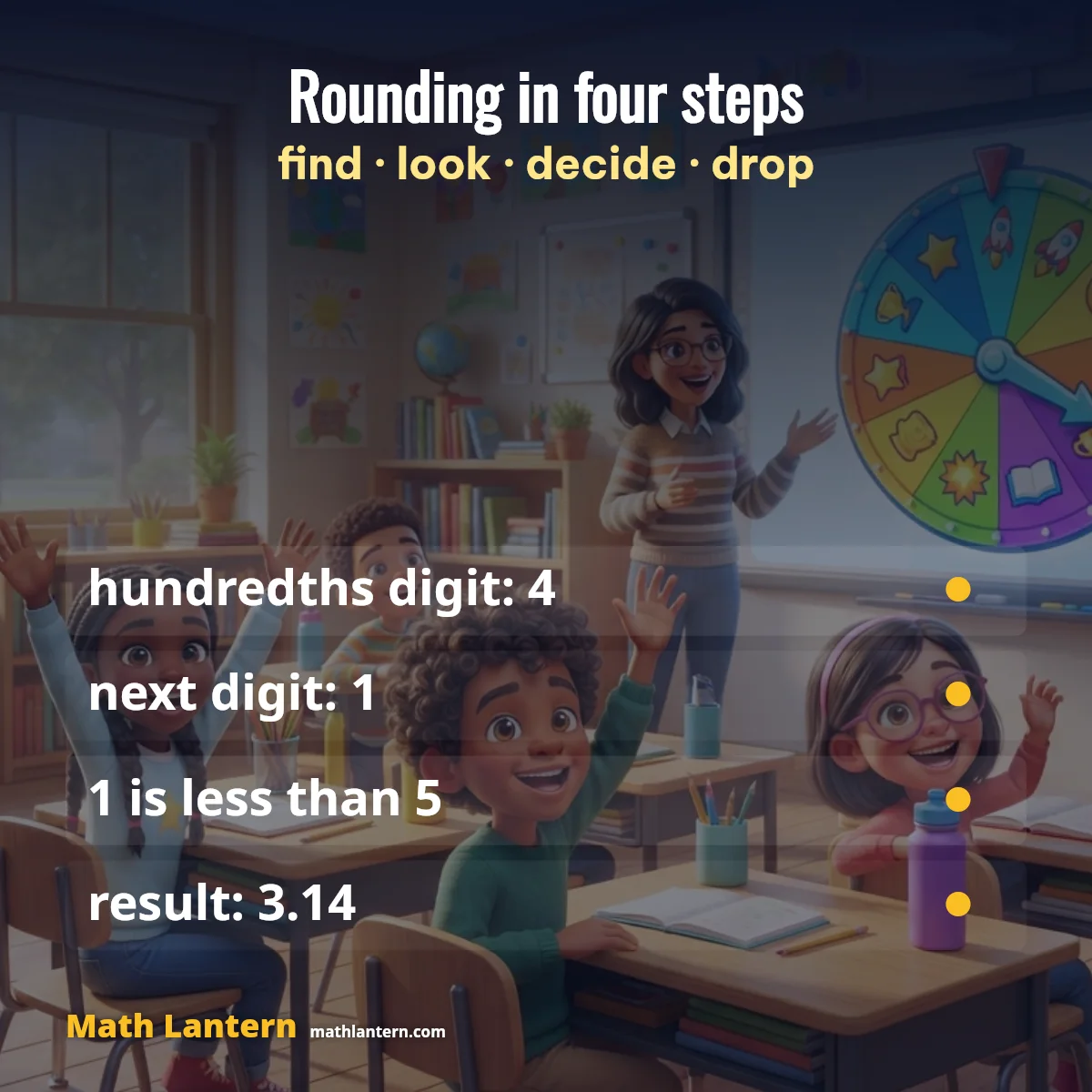
- Find the hundredths digit: 4.
- Look at the digit just after it, the thousandths digit: 1.
- The next digit is 1, which is less than 5, so round down: keep the hundredths digit as it is.
- Drop every digit after the hundredths place. Result: 3.14.
Math Lantern Team · Updated
How to round to the nearest hundredth
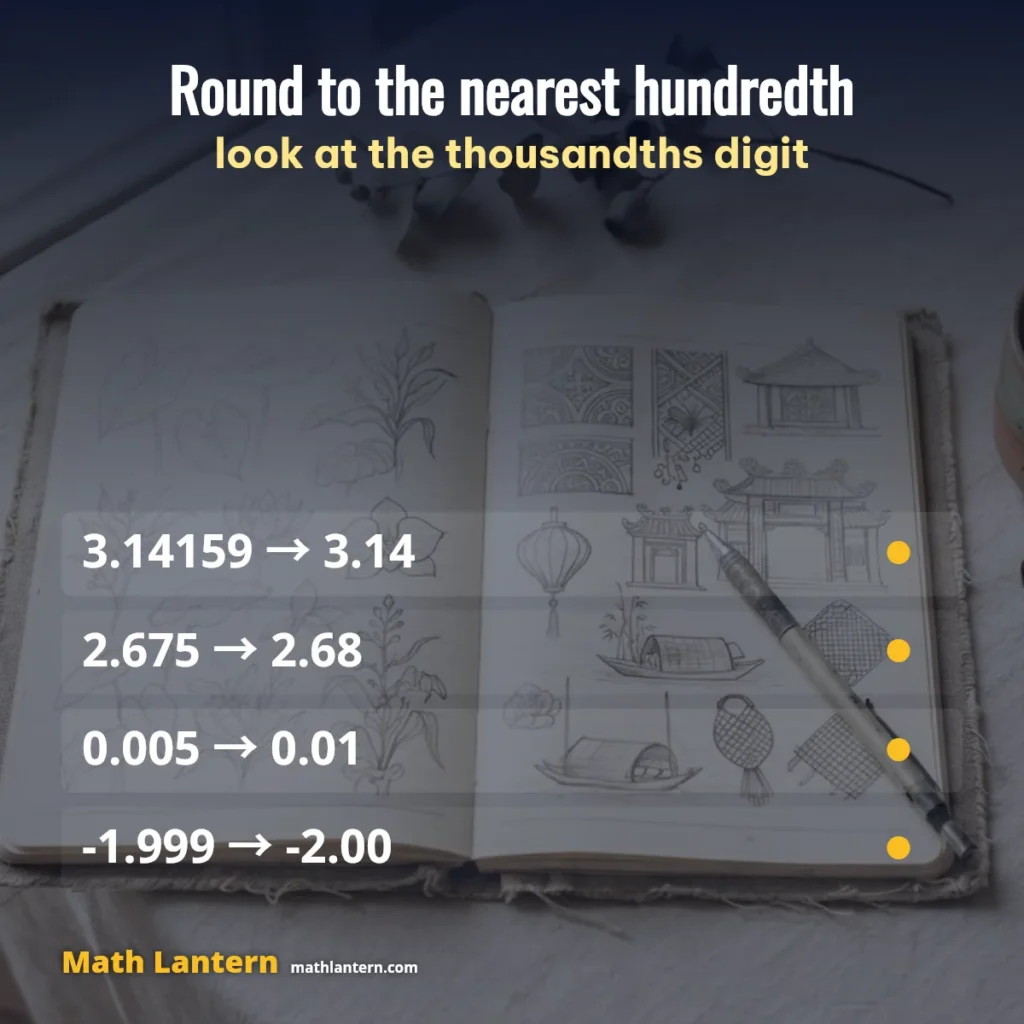
The hundredths place is the second digit after the decimal point. To round to it, look at the digit right after it, the thousandths digit. If that digit is 5, 6, 7, 8 or 9, add 1 to the hundredths digit. If it is 0, 1, 2, 3 or 4, leave the hundredths digit alone. Then drop every digit to the right.
Worked examples
- 3.14159: the hundredths digit is 4 and the next digit is 1, so it stays 3.14.
- 2.675: the hundredths digit is 7 and the next digit is 5, so it rounds up to 2.68.
- 0.005: the hundredths digit is 0 and the next digit is 5, so it becomes 0.01.
- −1.999: the next digit is 9, so 1.99 becomes 2.00 and the answer is −2.00. The carry moves all the way to the ones place.
- 45.6: there is no thousandths digit, so it is 45.60. The zero is kept to show the hundredths place.
Round half up or round half to even
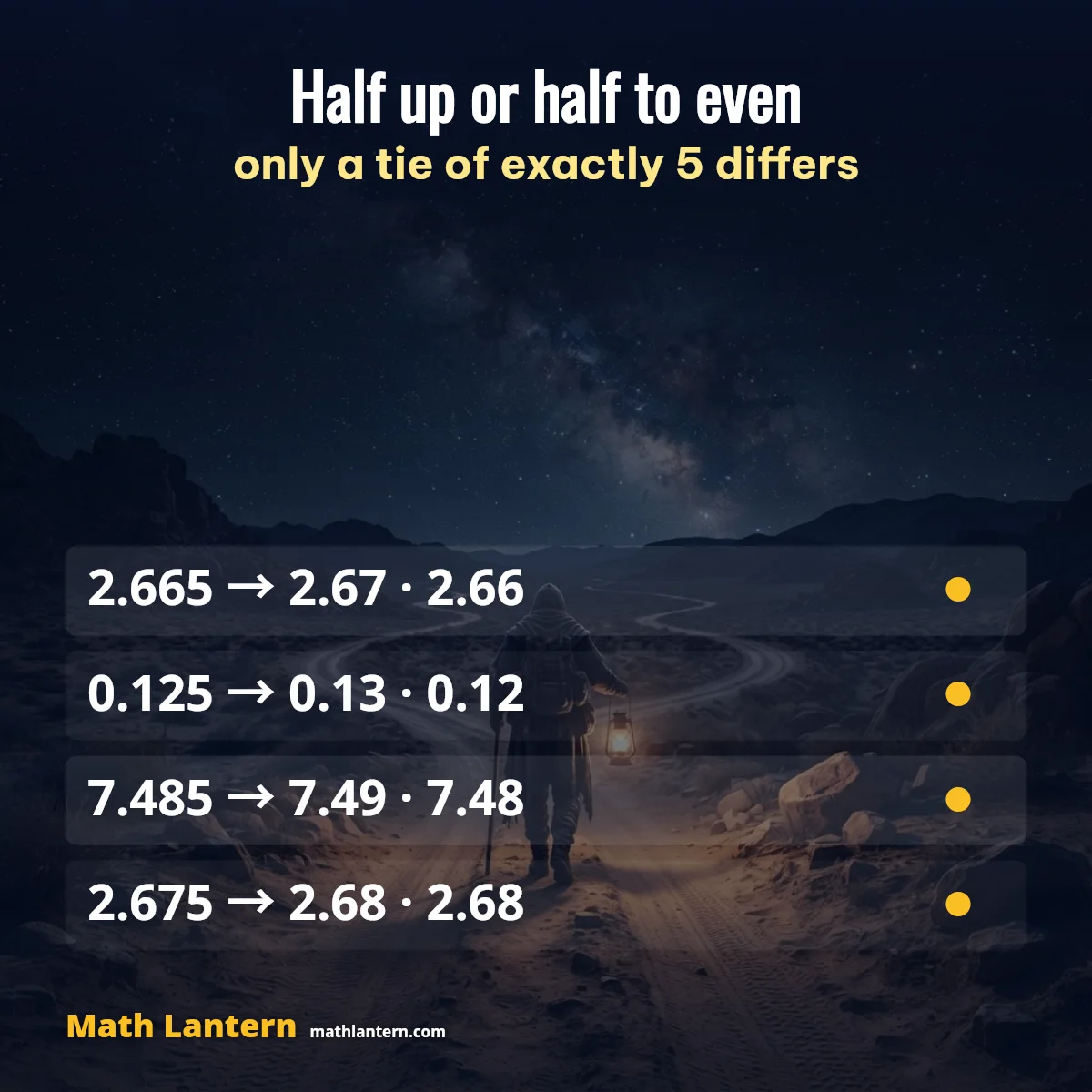
Most schools teach rounding half up: a 5 in the next place always rounds up. Some software uses round half to even, also called banker’s rounding, which sends a tie to the nearest even digit; the default rounding mode in the IEEE 754 floating-point standard works this way. The two rules only differ when the next digit is exactly 5 with nothing after it. Choose either rule in the calculator above.
| Number | Half up | Half to even |
|---|---|---|
| 2.665 | 2.67 | 2.66 |
| 0.125 | 0.13 | 0.12 |
| 7.485 | 7.49 | 7.48 |
| 2.675 | 2.68 | 2.68 |
Why the digits matter more than a decimal on a phone
This calculator works on the digits you type, not on binary floating-point numbers, so 2.675 rounds to 2.68 as written. Many programming languages store 2.675 as a slightly smaller binary value and print 2.67 instead. Working on the digits gives the answer you would get on paper.
Common mistakes
- Rounding in steps, for example 2.4449 to 2.445 and then to 2.45. Always round once from the original digits: 2.4449 is 2.44.
- Dropping the trailing zero. 45.6 to the nearest hundredth is 45.60, not 45.6.
- Looking at the wrong digit. For the hundredths place, the deciding digit is the thousandths digit, the third after the point.
How we checked it
Every example on this page was worked by hand and re-checked with a script on 22 October 2026. The round-half-up rule is the standard school rule, and round half to even is the default rounding mode of IEEE 754. For money, round to the hundredth to get cents.
Frequently asked questions
How do you round to the nearest hundredth?
Look at the thousandths digit, the third digit after the decimal point. If it is 5 or more, add 1 to the hundredths digit; if it is 4 or less, leave it. Then drop the rest.
What is 3.14159 rounded to the nearest hundredth?
3.14, because the thousandths digit is 1, which is less than 5.
Why does 0.996 round to 1.00?
The thousandths digit is 6, so the hundredths digit 9 rounds up to 10, which carries into the tenths and the ones place and gives 1.00.
Is the hundredths place the same as two decimal places?
Yes. Rounding to the nearest hundredth gives two digits after the decimal point.
Need to count digits instead? Try the sig fig calculator, or go back to Math Lantern for every calculator.
Did this light the way?
Tell us if the steps made sense or where they lost you.
Thanks. That helps us make the next step clearer.