Sig Fig Calculator
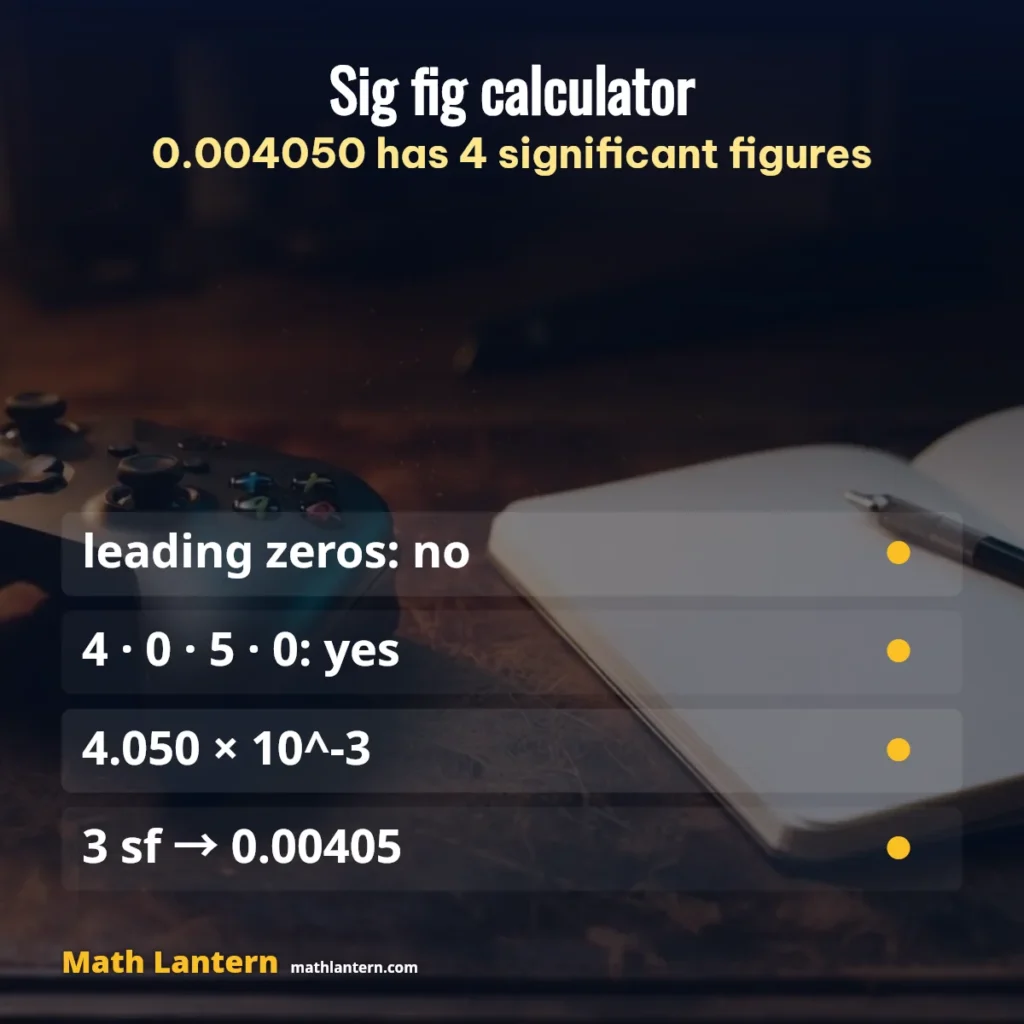
A sig fig calculator counts the significant figures in a number and rounds it to the number of significant figures you choose. Type a number such as 0.004050 to see which digits count, its scientific notation, and the rounded result, with each step of the working shown.
| Result | Value |
|---|---|
| Significant figures | 4 |
| Scientific notation | 4.050 × 10^-3 |
| Rounded to 3 significant figures | 0.00405 |
Working
- Write the number: 0.004050. Check each digit with the rules below.
- Skip the leading zeros, then count from the first non-zero digit to the last significant digit.
- 0: leading zero: not significant.
- 0: leading zero: not significant.
- 0: leading zero: not significant.
- 4: non-zero digit: significant.
- 0: zero between significant digits: significant.
- 5: non-zero digit: significant.
- 0: trailing zero after the decimal point: significant.
- Count: 4. In scientific notation: 4.050 × 10^-3.
Math Lantern Team · Updated
The rules for counting significant figures
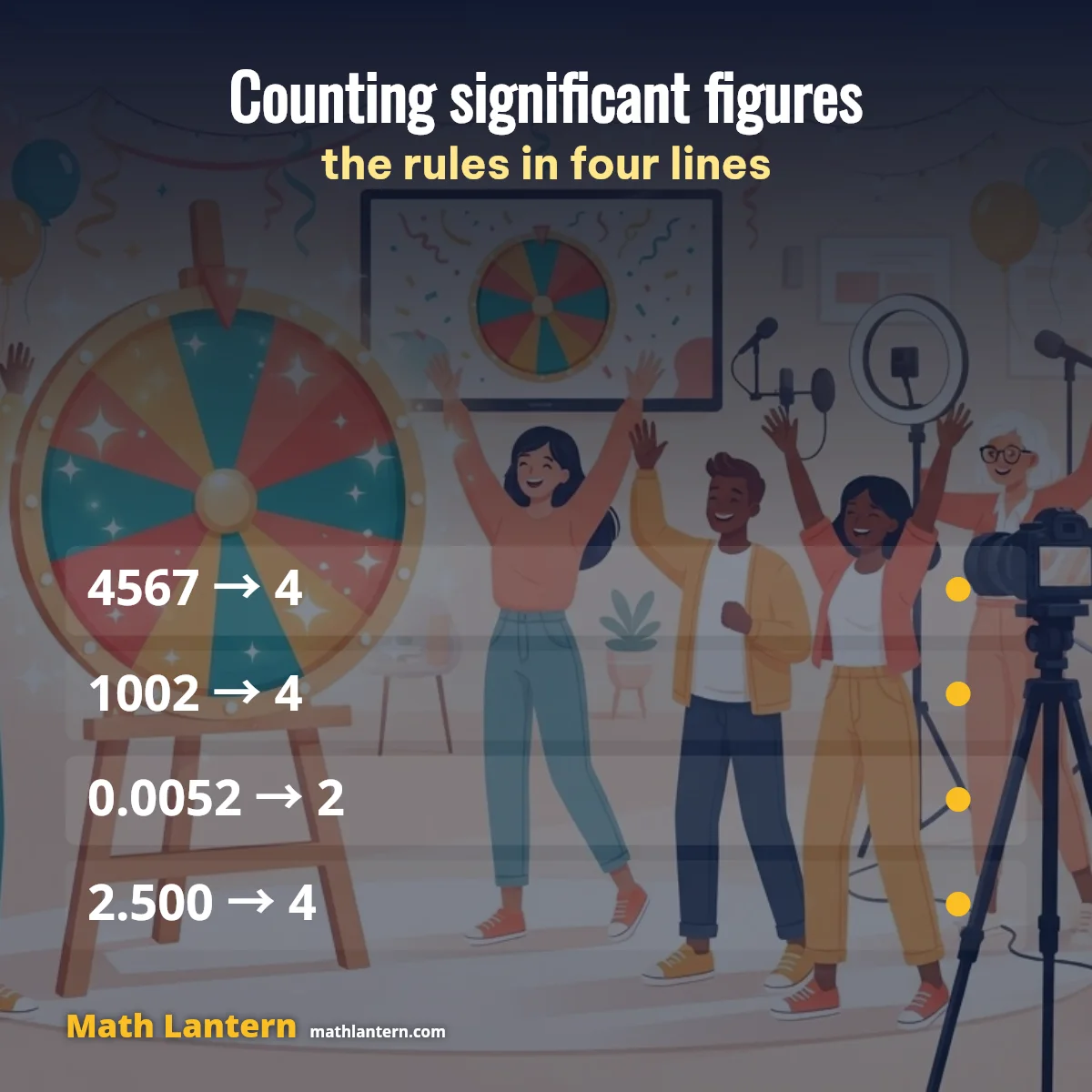
| Rule | Example | Sig figs |
|---|---|---|
| Every non-zero digit counts | 4567 | 4 |
| Zeros between other digits count | 1002 | 4 |
| Leading zeros never count | 0.0052 | 2 |
| Trailing zeros after a decimal point count | 2.500 | 4 |
| Trailing zeros in a whole number with no decimal point do not count | 1200 | 2 |
| A decimal point after a whole number makes its zeros count | 1200. | 4 |
| Scientific notation counts every digit in the first part | 1.20 × 10^3 | 3 |
A whole number such as 1200 is ambiguous, because the zeros might be measured or might only hold the place. This calculator follows the common textbook rule and counts them as not significant; write 1.20 × 10^3 or add a decimal point (1200.) when you mean them to count.
Worked example: 0.004050
The three zeros before the 4 are leading zeros, so they do not count. The 4 and the 5 are non-zero digits. The 0 between them is inside the number, so it counts, and the final 0 comes after a decimal point, so it counts too. That gives 4 significant figures, and in scientific notation the number is 4.050 × 10^−3. Rounded to 3 significant figures it is 0.00405.
Rounding to a number of significant figures
Find the first non-zero digit, count the digits you want to keep from there, and look at the next digit: 5 or more rounds the last kept digit up, 4 or less leaves it. For example, 123456 rounded to 3 significant figures is 123000, 0.0004567 rounded to 2 is 0.00046, and 9.996 rounded to 3 is 10.0, because the carry turns 9.99 into 10.0 and the zero after the point is kept.
Significant figures in calculations
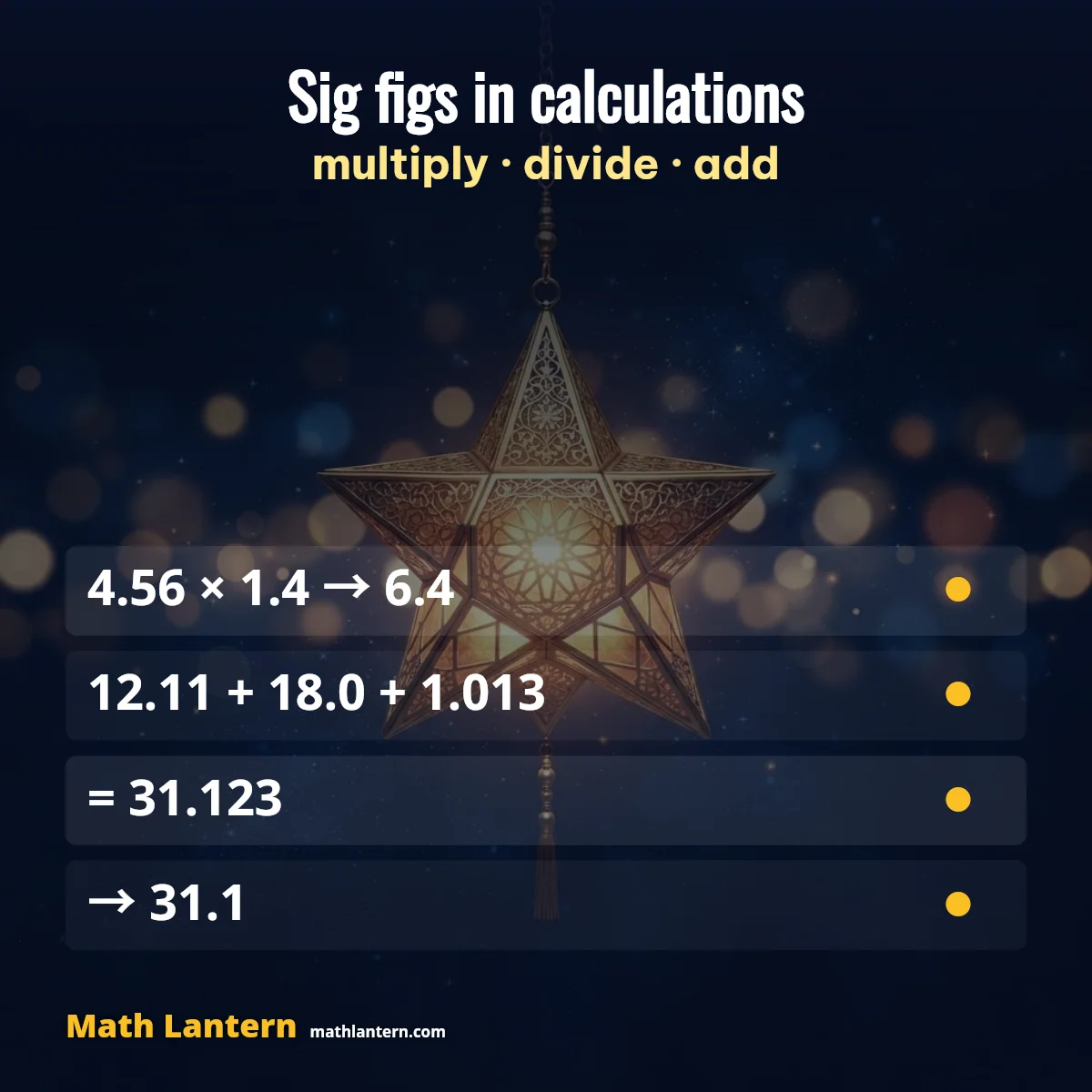
When you multiply or divide, the answer has as many significant figures as the factor with the fewest. For 4.56 × 1.4 = 6.384, the factor 1.4 has 2, so the answer is 6.4. When you add or subtract, the answer has as many decimal places as the number with the fewest: 12.11 + 18.0 + 1.013 = 31.123, and 18.0 has one decimal place, so the answer is 31.1. These are the rules taught in general chemistry and physics courses; your instructor may ask for a variation.
How we checked it
Every example on this page was worked by hand and re-checked with a script on 22 October 2026. The counting rules are the standard textbook rules, and where a textbook differs, for example on whole numbers that end in zero, the page says so.
Frequently asked questions
How many significant figures are in 0.004050?
Four. The leading zeros do not count, while the 4, the 0 between 4 and 5, the 5 and the final 0 after the decimal point all count.
Do trailing zeros count as significant figures?
They count when the number has a decimal point, as in 2.500, which has 4. In a whole number with no decimal point, such as 1200, they are usually treated as not significant.
How do you round to 3 significant figures?
Keep three digits starting from the first non-zero digit and look at the fourth: if it is 5 or more, round the third digit up; otherwise leave it. 123456 becomes 123000.
Are zeros between non-zero digits significant?
Yes. In 1002 the two zeros sit between non-zero digits, so all four digits count.
To round to a place instead, use the round to the nearest hundredth calculator, or go back to Math Lantern for every calculator.
Did this light the way?
Tell us if the steps made sense or where they lost you.
Thanks. That helps us make the next step clearer.